Wednesday, August 1, 2012

Tuesday, July 31, Thethi Valley, Albania

Add caption

Tuesday, July 31, Thethi Valley, Albania
            An easier day, a leisurely day, a rainy evening.
            We left the guesthouse around 8am as usual and descended a few hundred meters to the village below. The weather was cool, the scenery was scenic; mountains to the left of us, mountains to the right of us, mountains all around us. We found the local waterfall:
            The water was too cold for me. The best I could do was to enter up to my ankles, but Francesco was more thick-skinned:                 
            Tomorrow is our last day and it will be spent driving back to Tirana.
            “Johnny”, Francesco’s dad was our most voluble and enthusiastic member despite the fact that he is 72 years old. If we met other travelers, as we repeatedly did today, it was Johnny who quickly found openings for rapid-fire, animated conversations. It helped that he spoke respectable amounts of several languages, his native Italian, Albanian, French, German, English, and Arabic. There were probably others that he didn’t get to use here.
            It is from Johnny that I learned three lessons:j
1.              Don’t give up on learning the local language. A little grasp of the tongue gives you opportunities to communicate (and thus rapidly increase your fluency with that same language). Because I spend so little time in any one nation I give up on the idea of trying to use at least some of the simplest words.
2.              Every year I ask myself if I’m too old to keep doing this traveling thing—or at least too old to do the athletic things. But Johnny showed me that you can still bound over rocks and climb steep pathways in your 70’s.
3.              I need to get back into the gym and do at least some minimal exercise every week so that I can remain active in the summers. Johnny hikes in the Italian Alps every Sunday. 
Francesco in the waterfall

It’s amazing how far away Oakland seems from here. By here I don’t only mean an isolated valley in NE Albania; I also mean five weeks into the summer. I hardly feel as if that other part of my life exists.

Monday, July 30, Thethi Valley, Albania


            A hard day, a tiring day, a satisfying day.
River at the base of the Thethi Valley
Our group plus the Poles and a Frenchman meeting at the top of the pass separating Valbona from the Thethi Valley.
            We hiked uphill to 2,000 meters to start the day. I was very worried, after yesterday’s difficulties, that I’d not be able to accomplish this day’s hike, but I got it done without great difficulty and without any pain or discomfort. It was a wonder to me. The summit today was a pass between two mountains. We arrived at the pass to find a group of Poles with one Frenchman resting after a climb from the other side.
There were springs everywhere, very convenient for refilling water bottles.
            Next we descended the other side.  That turned out to be the most arduous part of the day. Three hours of walking steeply downhill made my knees almost rigid and unbendable. And my back seemed to acquire a permanent scoliosis. Yet we had one more bit of business, a thirty minute trek directly uphill to our guesthouse. It was during that last portion that my body really began to give out. There was no pain, just deep fatigue. That last few steps to our destination seemed immense.
            The remarkable thing was that I had none of the real pain of yesterday. It seems as if my body will allow me to finish these five days. That is a great relief.

Sunday, July 29, Mt. Ribot above Valbona Village


            A depressing day, a pain-filled day, a hot day, a disappointing day.
            We began our day with breakfast in the guesthouse, and then set off to bestride the surrounding mountains. I was worried that I wouldn’t be able to keep up. Even before I got out of bed I could feel my heart pulsing in my back and soreness behind my left foot. What brittle part of this elderly body would betray me? Would my heart give out? But at least it was cool when we began.
            I glanced up to the jagged, bald peaks around us.
The mountain we were about to climb.
            “Could we really be going up there?” I thought to myself.
            We hadn’t gone more than 300 meters when our Albanian couple dropped out. I couldn’t understand what they said to Enric, our guide, but their body language gave hints that they weren’t happy.
            “This is too much for us,” is the gist of what I think they said. Enric made a quick phone call and soon the couple were headed back to our first-night’s lodgings. They would be getting a lift to the next rest stop. The remaining group of six would be continuing our trek.
            One part of that decision affected me directly. I had counted on the Albanians, who I knew were the least fit of the group, to slow us down so that my failings wouldn’t be so obvious. Now I was the weak link. No telling what that might mean.
            The other part of my angst was the fact that I felt so isolated. Remaining in our group were a father and son from Italy and two young Australians who had hit it off seamlessly. As the only two real English speakers they were my only possible conversation partners, but it looked like they were so into each other that I would be a relative exile.
            The guesthouse sat at about 1,000 meters above sea level. The mountains looked to be about 3,000 meters. How much of the difference would we make up with our mountaineering? I didn’t know and Enric wasn’t saying.
            On we marched. I tried mightily to keep pace with Enric at first, and then it became a matter of simply maintaining contact with the group. I didn’t find it easy. Enric was a different kind of leader than the ones I encountered in Laos and Guatemala and elsewhere. He had little interest in chatting up our group members or doing much of anything to build comradery amongst us. He set his nose upward and strode briskly in that direction. Every 20 or 25 minutes he’d glance back.
            For the first hour I kept pace with the others. Giovanni, the dad of the Italian pair, or Francesco, his son, kept behind me to monitor whether I was having any difficulty. Giovanni testified that he spent every Sunday trekking through the Italian Alps, so he was clearly ready for anything Enric was likely to throw at us. His son was a triathlete—‘nuf said.
            Robert and Natali, the two Australians, took the lead behind Enric. As youngsters they had the toughness to handle any climb.
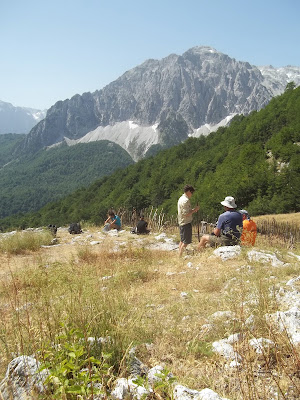
Resting at 1,700 meters.
            The question was whether I could keep up.
            The first hour was a riverbed full of sharp stones but the slope was modest and I had no trouble with it. But then we entered a pine forest. The slope was steep. There was blessed shade but my body took much punishment.
            My breathing became labored, my legs felt like two lead anchors that had to be dragged forward. I wanted badly to be a part of the group’s journey but my body wasn’t feeling the same way. We stopped for breaks periodically and that saved me but the pace that Enric was setting was daunting. We walked for about an hour in the shade but then reached the tree line. Suddenly we were in full sun, which added one more agony to my suffering. We rested at 1,700 meters. The peak of Mount Rosit was to our right. Enric announced that we’d climb for about one more hour, and then eat lunch (which we’d brought along). My back was sore, my feet were heavy, the air was cool, which helped, but I had doubts about my ability to make that last hour.
            Then Francesco, the triathlete, decided to retreat. He parted ways with us and headed down the mountain. There were four of us left plus Enric.
            I told Enric I didn’t know if I could make it all the way. He’d told us that the return route was simply a doubling back on our upward path so I knew I could stop and wait for the fit ones to crest the mountain and return to pick me up, if that was necessary.  But I really wanted to make it to the top. I really wanted to eat lunch with the group. I’d felt so alone, so much an outsider on this climb that I passionately wanted that vindication of a shared lunch.
The fit ones disappearing. They made it to over 2, 000 meters.
            But it wasn’t to be. The four fit folk quickly advanced ahead of me. Soon they were hundreds of yards further up the path. And my head began to spin. I sat down, hoping that a brief rest would help me reclaim my equilibrium, but it didn’t work. As soon as I stood up my whole body felt like I’d just gotten off one of those carnival rides that spins you round and round till you don’t know how to remain erect.
            I slumped down, defeated. I lay out for about twenty minutes (the group had long disappeared over the next rise) then sat up and ate my lunch. I made it, by my rough estimate, to 1,800 meters, but the pain of my failure was all I cared about.
            Dejectedly I began the long, slow descent, following the path I recently trod upward. My back pain increased and my legs began to lose their turgor. Natali had found me a walking stick, which saved me from crashing to the ground repeatedly. I dreaded the thought of having the fit folks overtake me and leave me, once again, behind.
            I made it reasonably far down the mountain before Enric and his crew caught up. We took a long rest under a nearby tree, long enough for my legs to recover most of their former glory. It took us about another hour to finally return to the elevation from which we’d originally ascended. But there was one more bit of pain awaiting me.
The view from 1,800 m. This is as far as I got.
            There was one more segment of our journey, a 20-30 minute flat walk to our new guesthouse. It was hot. Our path was across a dry riverbed filled with stones. I quickly fell behind the other five (Francesco had rejoined us). All my frustrations of the day came to the fore. Enric and the fit group were 200 meters ahead of me, oblivious to my feelings of isolation and abandonment. Why couldn’t they slow down to include me in their journey? I didn’t understand. And I held Enric mostly responsible.
            So when they came to a rest point I asked him:
            “Do we need to be at the guesthouse at any specific time?” I asked.
            “No,” he replied.
            “Then, do you think you could slow down a little and let me be a part of your group?”
            Behind his sunglasses I could “see” Enric glaring at me.
            “You think I’m going too fast?” he asked with a sharp edge to his voice.
            “All I can say is your going faster than I can walk,” I replied.
            “Sir, I wish you’d told me this before. I like to know these things.”
            “What did you think when you saw me so far behind?” I queried testily.
            Now I’d angered the guide. Would he ban me from the next day’s hike? Would he speed up his pace tomorrow to humiliate me? Did the other group members hear my complaint? Would they ostracize me?
            I didn’t know the answers to any of these questions. And I didn’t know if I was physically capable of doing tomorrow’s climb, anyway.
            What should I do on Monday? Quit the tour? Try to skip one day’s climb? Try to join the climb as if nothing had happened? I didn’t know.
            And should I explain to the other group members my sense of exile?
            All good questions.
           

Saturday, July 28, Valbona Valley, NE Albania

A very crowded ferry on Lake Koman.

Add caption
Saturday, July 28, Valbona Valley, Albania
            The Valbona Valley is in Northeast Albania. I’ve never been to Yosemite (!) but I have been to Mt. Zion in Utah, and this place reminds me of there. To get here we boated up a reservoir for about three hours. Albania’s Hetch Hetchy. As you ferry up the lake you can sense the lost valley below the water.
Mts above our guesthouse, first night.
            Once we finished the boat ride we boarded an eight-passenger van for a torturous two-hour ride over unpaved mountain roads. We are seven (eight counting the guide): two Italian men, a middle-aged Albanian couple, and two young Australians (who hadn’t met before this morning). The bad part about all that is that everyone has a partner except me, but that’s the usual lay of the land when I do these tours so I’m accustomed to it.
            Albania resembles California a bit. It has a broad central valley with Tirana, the capital at its northern extremity. To the west is the sea; to the east are mountains. Here in the northeast the mountains are large, 3,000+ meters, and the land is remote from the urbanity of the rest of the country.
            We are staying in a guesthouse that someone has appended to their farm. The farm sits in a small valley surrounded, of course, by the mountains. They have their portion of corn and other row crops plus some cows, a horse, and other farm animals. You need to watch your step around here owing to the cow poop that is everywhere. They have apples trees and prunes plus the inevitable grape vines.
            It’s cool up here, a pleasant change from the heat we left behind this morning. Any lesser smells are overmatched by the cow dung aroma that dominates your nostrils wherever you go.  
Stream near our guesthouse, first night.
            We’re just about at the level where the broadleaf trees, mostly beeches and birches, give way to pines and firs. About 1,000 m. above us is the tree line, finally surmounted by about 500 m. of treeless mountain tops.

Friday, July 27, Berat and Tirana


My money troubles were not over. I got to the Western Union office early. The manager of the place and her assistant were there. They knew I was coming and welcomed me. They asked for my passport. They sat at the computer and began, I thought, to put through the paperwork that would get me that precious cash.
            Time passed. The manager and the assistant engaged in an energetic conversation in Albanian. Their body language bespoke some kind of trouble. I began to despair, again. I read every map in the outer office of the little building that housed WU. Then I read them again.
            “This name, Alan, this is your other name?” she asked me.
            “Yes, my middle name,” I plaintively responded.
            More heated conversation from the two ladies.
            “This name, Alan, it is not on the paperwork. It is only on your passport. I don’t think we can give you the money.”
            Fury and frustration warred inside me. But I kept my cool. I simply gave them a pained look.
            “Let me call Tirana,” the manager offered.
            That took ten more minutes.
            Then there was some scuffling around inside, then she called me inside again.
            “There is your money, please count it,” she said.
            I was so nervous I miscounted the first time, but she was certain she’d counted correctly and, after my second count, I was on my way. I paid my bill at the hostel and bounded down the hill towards downtown Berat and the bus station.  I quickly found a fourgon with “Tirana” in the windshield. After a bit of a wait I was on my journey back to the capital.
            I got lost in Tirana, as usual (my Lonely Planet map was safely stowed in my backpack) but this time the gods were with me. As I drifted along an unfamiliar avenue I looked to my left and there was a vaguely familiar face. It was the guy who checked me into the backpacker’s hostel last week. He recognized me. Soon we had my backpack on his bicycle and we were off to another night’s lodging.

Thursday, July 26, 2012

Thursday, July 26, Berat

Just telling this story is humiliating because it, again, reveals my ineptitude at life in general.

First:  I learned two years ago, when I got stranded in northeast Laos with no funds, that it pays to carry a couple hundred US dollars secreted away for emergencies. I did that this year. Except that, early in my trip, someone in Croatia--I forget who--insisted on dollars. So I ended up spending most of my secret stash before the trip really got started. (Why I didn't replenish my fund with euro's I can't explain).
When I got to Berat I had about 10,000 Leks, the Albanian currency; equivalent to about a hundred dollars US. I also had my ATM card and two credit cards. And, unlike Northeast Laos, there were several ATM's in Berat.
My first day here I tried to use an ATM. No luck. But I didn't worry since I'd taken out nearly $300 the day before. I figured I'd taken the daily maximum and things would straighten out the second day here.
On the second day the ATM's (I tried three) all rejected my card. Now I began to worry. But I still had my credit cards if something went really wrong. I wanted to call the bank but my phone (despite what a T-Mobile guy told me before I left) wouldn't function here.
Today, the third day, I went to a mobile phone company to get a SIM card. But even after the card was installed I couldn't use the phone. I needed badly to call the bank to get my ATM card reactivated. I knew that there had been three fraudulent transactions on my card and assumed the bank had temporarily suspended the card while investigating the false charges.
I went to a local bank for help. The banker said she couldn't do much for me but she did ferry me to a nearby convenience store that had an international phone in it--for a fee, or course.
I called the bank.
"Your account is cancelled and I can't reopen it," said the Wells Fargo lady. I asked if I could use my credit card to get a cash advance. She seemed to think I could, so I hung up and headed for another bank.
"Put your credit card in out ATM machine and enter your PIN," they told me.
I told them credit cards didn't have PIN's in the US. They were nonplussed at that. I tried this at three banks. All had the dame answer:  no cash advances for your credit card.
Now I was very concerned.
I went back to the convenience store and called the bank back. The woman on the line was solicitous and said she'd try to help me. She put me on hold......for twenty minutes. With every minute my funds were evaporating at about two dollars/minute. Finally she came back and said...you must call back in two hours when our Executive Office opens at 6am, PST.
Dejectedly I hung up. I was down to my last $40 and worried that I couldn't afford another phone call like that one.
Ninety minutes later I returned to the shop. The lady shop owner, knowing that I had to scrounge my pockets for the last call, looked askance at me. Somewhat dubiously she allowed me to call again. This time I got the Executive Office quickly. I explained my dilemma. At first he didn't understand the depth of my problem, but finally I got through. He pondered, then suggested he could send me a Western Union wire transfer. How much would I need? I said five hundred dollars would probably get me back to New York in August. He agreed to send it to me. I rejoiced. He put me on hold.......for 25 minutes. As the minutes went by I kept glancing at the lady behind the counter, and at my wallet. I was fairly certain I wasn't going to be able to pay for the call, but I couldn't bring myself to hang up. I felt like, if only I could hang on for a little while longer this guy will save me.
Then he came back on....and told me he couldn't send the money. Western Union demanded to be able to call me before they'd authorize the funds. But they couldn't call me, this was just an outgoing phone. And how would I explain to this lady, who spoke only Albanian, that I wanted her phone number so my bank could call her. I went into major despair, and hung up. I poured through my pockets and found some loose American dollars, enough to fund the call, and leave me with 100 Leks (about one dollar). That was all the money I had left.
I owed about $70 at the hostel where I was staying. And there was the matter of eating. I was dead broke.
I trudged back in the direction of the hostel feeling defeated. Before I got all the way back I recollected a friendly banker I'd spoken to who offered to lend me cash. I skulked back to his bank and asked if he'd lend me his cellphone so I could make one more call to my bank. He agreed. I dialed the number and got back in touch with the guy I'd just spoken to.
"I'm glad you called," he told me. "I think I can get the $500 to you." My spirits brightened, but no completely. After all the previous near misses I didn't trust this ray of hope.
He put me on hold. For 15 minutes! I kept my head down, not wanting to make eye contact with my banker friend. I was afraid he'd make me hang up.
"I need my phone," I imagined him saying. And I couldn't blame him.
At one point my California banker came back on line.
"Mr. Heverly, are you still there?" he asked, then put me back on hold. I'd missed my opportunity.
"Hey, wait! I can't stay on hold here," I wanted to tell him. But he was gone.
Another five minutes passed.
Then he came back. He had the code number. With that number I could go to Western Union and collect my $500. I was saved.
Except I didn't believe it. I was certain something else would go wrong. And it did.
Western Union was closed. I trudged dejectedly back to the bank, where they explained to me that the Western Union office, like mos
 t of Albania, closed in the heat of the afternoon. It would open in 40 minutes they told me.
So I plodded back to the office.  And, sure enough, at 5pm the office opened. I was first in line. At first the lady behind the counter was encouraging. She showed me the yield I'd get in Euro's (404). I remained patient.
Then she began speaking, at length, to someone on the phone. He intonation told me all was not copacetic. This went on for ten minutes. Finally she gave me the phone. I heard another woman talking. I didn't understand all that she said, in her thick Albanian accent, but eventually I heard something intellligible:  "(muffled)....problem. Can you come back tomorrow?"
And thus, here I am in the hostel, broke, but hopeful. Tomorrow will tell the tale.      

Wednesday, July 25, Berat

View from my hostel, Berat.
Add caption


My body was sore all over from days of hiking up mountains so I decided to loaf all day here.

The one thing worth mentioning at this point is that we don't often hear in the US about secular muslim states, yet Kosovo and Albania clearly are such. There are fewer scarves and birkas here than in San Francisco, and more short skirts on the streets of any Albania city than in Hollywood. There doesn't seem to be much capitalist buzz, however. Life is at a slow pace and hanging out in cafes is the main recreation for men of all ages. There is some construction going on but you don't get the impression that there is much 'industry' hereabouts. Making money is, of course, on people's minds but this seems to amount, mostly, to opening a shop selling cellphones or tourist trinkets. 

Albania has been bounced around so often in the past century it's a wonder there is any Albania identity left. Turkish occupation till 1912, brief democracy, a king for twenty years or so, invasion by Mussolini, occupation by Hitler, then the Commies. Enver Hoxha's dictatorship of the proletariat was as rigorous as any on the planet. He found Mao insufficiently socialist and cast the chinese out in the 70's. Then, finally, this soporific democracy that they have now.

I get the impression that most Albanians would like to incorporate Kosovo within Albania. But in Kosovo I heard only pride about independence. So Kosovo's independence seems genuinely tentative with the Serbs on one side and the Albanians on the other, both coveting their territory.